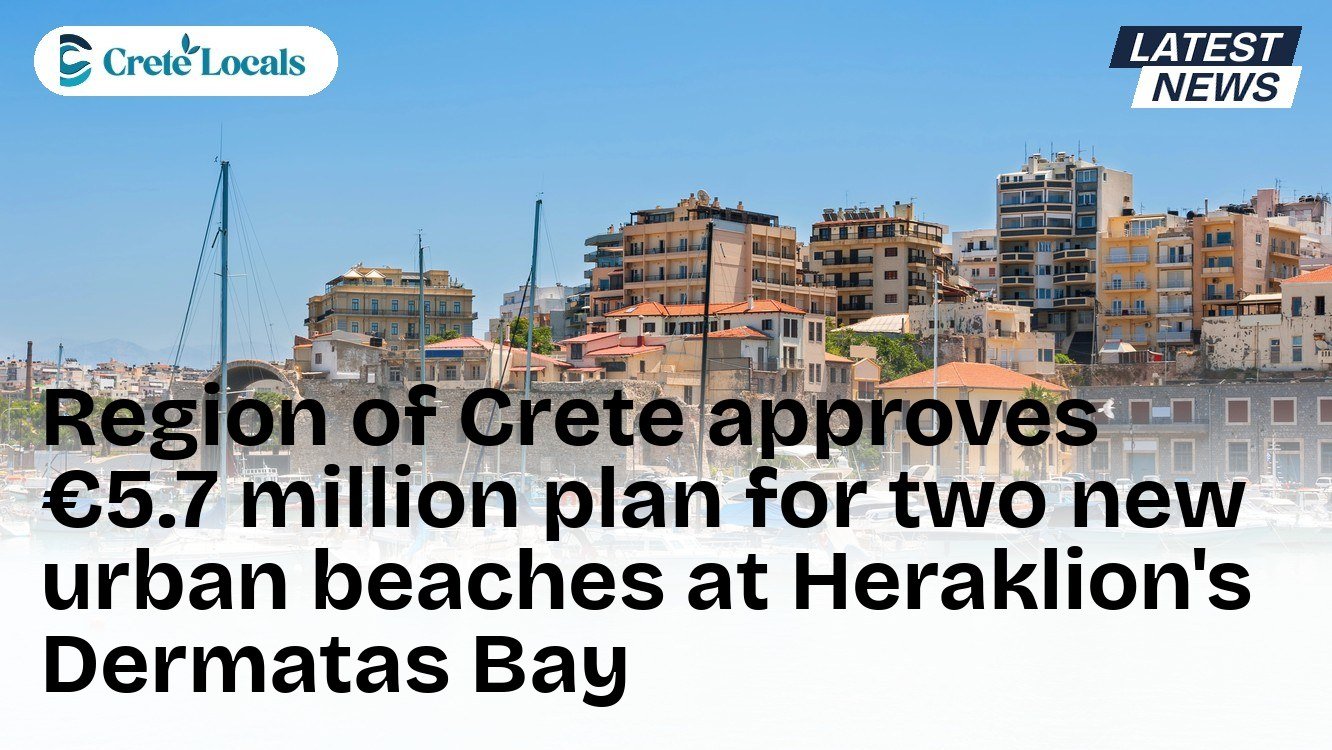
Region of Crete approves €5.7 million plan for two new urban beaches at Heraklion’s Dermatas Bay
The Region of Crete has formally included a €5.7 million anti-erosion and coastal renovation project for Heraklion’s Dermatas Bay in the “Crete 2021-2027” funding program, moving the plan into its next implementation phase.
Regional Governor Stavros Arnaoutakis signed the inclusion decision for the “Anti-Erosion Protection of the Coastal Zone of the Old Power Station, Municipality of Heraklion” project. The renovation carries a total budget of 5,716,100 euros, is financed by the European Regional Development Fund, and has a three-year implementation timeline. The Municipality of Heraklion is the project’s beneficiary, with the Ephorate of Underwater Antiquities and the Ephorate of Antiquities of Heraklion participating as co-beneficiaries.
Two new beaches planned around the museum
The most visible change is expected on either side of the Natural History Museum of Crete. Through artificial replenishment of the shoreline, the project calls for two new beaches with a combined length of 410 meters: one measuring 240 meters to the east of the museum and another measuring 170 meters to the west.
To shield the new shoreline from strong wave action, the plan includes construction of two submerged breakwaters along with reinforcement work using suitable materials. Officials describe this component as critical, since the area currently experiences significant erosion and undercutting.
Waterfront renovation and archaeological surveys
The intervention also extends beyond the shoreline itself. At Dermatas Bay, the project envisions a broader aesthetic and functional renovation of the waterfront, including ramps, retaining walls, new paving and walkways. Plantings, irrigation networks and new street lighting are also planned, while maintenance and restoration work on existing infrastructure will take place west of the Natural History Museum.
Given the area’s historical and archaeological significance, the project incorporates the necessary archaeological and underwater surveys, to be carried out under the supervision of the relevant Ephorates.
Officials describe the project’s aims
Arnaoutakis said the Region of Crete is prioritizing protection of the island’s coastline. “With the inclusion of this project, worth 5.7 million euros, we are reinforcing the area of Dermatas Bay and the Old Power Station against erosion and extreme weather phenomena,” he said, adding that the work is being carried out in close cooperation with the Municipality of Heraklion and the relevant Ephorates of Antiquities. He described it as part of a wider program of urban renovations under way in Heraklion, Rethymno, Chania and Agios Nikolaos.
Heraklion Mayor Alexis Kalokerinos said the project would also help protect the city’s Venetian Walls. He noted it is linked to a separate, already contracted project to reinforce the coastal wall at Bentenaki, which he said is expected to begin within the coming weeks. Kalokerinos said the Dermatas intervention would produce “a double urban beach” at the edge of the Agia Triada neighborhood, calling it part of joint planning with the Region of Crete that also includes the Neoria project, which he said is currently in its tendering process.
The mayor thanked the Managing Authority, represented by Maria Kassotaki, along with the deputy mayors involved in the project, the Ministry of Culture, the design team and municipal staff, saying the project has a dual inclusion in both the city’s Sustainable Urban Development Strategy and the joint program agreement for the protection of the Venetian Walls.
The Dermatas intervention is described as connecting with other projects at various stages of planning and implementation along Heraklion’s waterfront, with officials saying its distinguishing feature is the aim of restoring public access to the sea in the city center through the creation of two new beaches at the edge of Agia Triada.