Crete leads Greece’s regions in international air arrivals for first seven months of 2026, INSETE data show
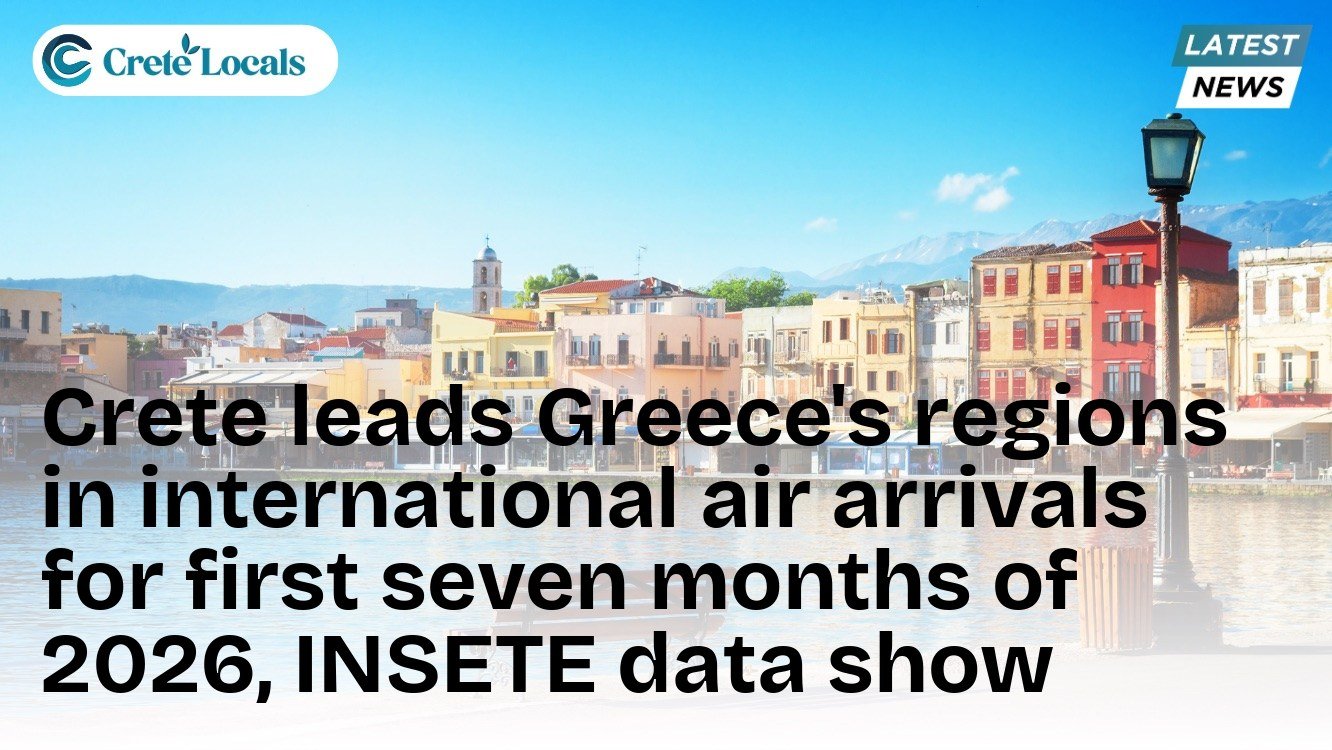
Crete recorded around 3.2 million international air arrivals between January and July 2026, the highest total among Greece’s geographic regions, according to the August Statistical Bulletin published by INSETE Intelligence, the research arm of the Greek Tourism Confederation.
The figure represents an increase of about 217,000 arrivals, or 7.2%, compared with the same seven-month period in 2025. Nationally, Greece’s main airports registered 15.7 million international air arrivals in the period, up roughly 541,000, or 3.6%, year on year. In July alone, arrivals exceeded 5 million, a 3.2% increase over July 2025, INSETE said.
Crete tops regional rankings
Among Greece’s geographic tourism regions, the Dodecanese followed Crete with about 2.5 million arrivals, up 2.4%, while the Ionian Islands recorded 2.3 million arrivals and a higher growth rate of 6.6%. The Cyclades logged 668,000 arrivals, an increase of 4.7%, and the Peloponnese, though far smaller in volume with 154,455 arrivals, posted the largest percentage increase of any region, at 15.2%.
Analysts note that this year’s growth in Crete tourism is not concentrated only in traditional top destinations, with several smaller regional airports also posting strong gains.
Athens dips as regional airports grow
By individual airport, Athens remained by far the busiest with 4.88 million international arrivals in the seven-month period, but it was among the few major destinations to record a decline, down about 42,000 arrivals, or 0.8%, with a slight downward trend from April through July, INSETE reported.
Thessaloniki’s airport reached 1.61 million arrivals, up 6%. Heraklion airport surpassed 2.26 million arrivals, a 5.6% rise, while Chania approached 1 million international arrivals, at 959,959, marking an 11.3% increase. Rhodes recorded 1.71 million arrivals, up 3.7%, and Kos saw a slight decline to 729,000 arrivals, down 1.2%. Air traffic growth at Heraklion has drawn attention to broader capacity questions, including ongoing works at the future Kastelli airport project.
Smaller destinations post the sharpest growth
When ranked by growth rate rather than absolute arrivals, the picture shifts, according to figures cited by ot.gr. Kalamata airport posted the largest increase among the airports in INSETE’s table, at 20.8%, reaching 107,127 arrivals, followed closely by Samos with a 19.5% rise to 86,305 arrivals. Karpathos grew 13.9%, Skiathos 12.1%, and Chania 11.3%.
Mykonos also performed strongly, with international arrivals up 9.5% to about 317,000. Corfu recorded roughly 1.21 million arrivals, an 8.3% increase, while Kefalonia grew 8%. Zakynthos rose 3%, and Santorini’s arrivals were nearly flat, up just 0.7%. Outside of Athens and Kos, Kavala and Mytilene were the main airports to record declines, falling 8.8% and 7.7% respectively.
Travelers arriving in the region continue to face some logistical bottlenecks, including reported passport control queues at Heraklion airport during peak periods.
INSETE’s data indicate that this year’s rise in Greek tourism is not driven solely by the country’s traditional leading destinations. Smaller airports such as Kalamata, Samos, Karpathos and Skiathos posted double-digit growth rates, while the strong performance of Chania and Crete overall further reinforces the island’s position as the largest regional hub for Greece’s inbound tourism, according to the bulletin.