
How to Get from Chania to Heraklion: Car Rental, Bus, Taxi, Flight

Chania to Heraklion is about 140 km to 150 km by road on the E65/E75 north-coast highway, and about 162 km from airport to airport. The drive takes 2 to 2.5 hours, occasionally 3 hours in heavy summer traffic or around roadworks. You have 5 practical ways to make the trip: rent a car, take the KTEL bus, book a taxi, arrange a private transfer, or fly with a change in Athens. Car rental is the most flexible option, the KTEL bus is the cheapest at €17.60 a seat, and the KTEL EXPRESS service covers the route non-stop in about 2 hours.
Chania and Heraklion each have their own international airport, Chania Airport (CHQ) and Heraklion Airport (HER), and Heraklion handled about 2.4 times as many passengers in 2025. Many visitors fly into one city and out of the other, so they never backtrack along the same road twice. For that itinerary, a one-way car rental picked up in Chania and dropped off in Heraklion, or the reverse, is usually the simplest option, since it removes the need to double back for a return flight. Both cities have affordable restaurants and hotels, so food and accommodation are easy to arrange at either end.
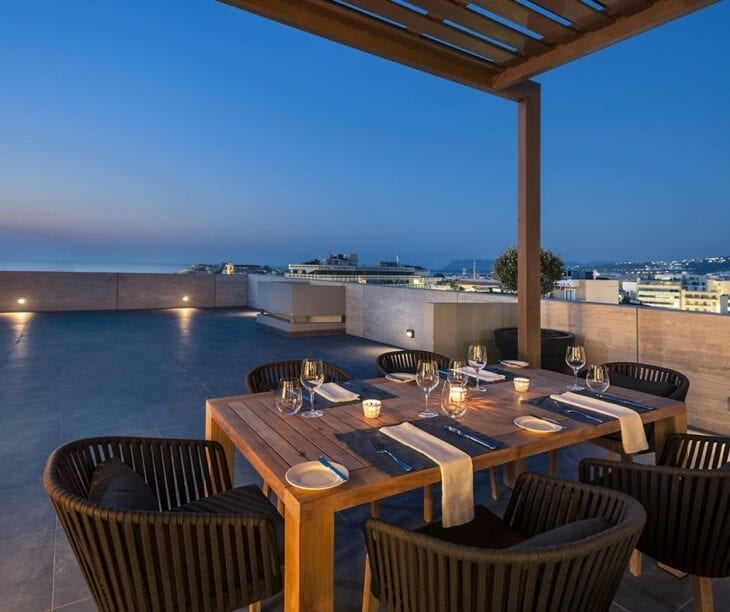
What is Chania?
Chania is the second-largest city on Crete, on the island’s western side between Kissamos and Rethymno. Its coordinates are 35.51382, 24.0180. Chania traces its history to the Neolithic era, when it was known as Kydonia. It grew into an important Minoan and Classical-era city-state, then passed to the Byzantine Empire. The Republic of Venice held the town from the 13th century, the Ottomans took it in 1669, and Crete gained independence in the early 20th century. Walking through the old town, you can see the Egyptian lighthouse, Venetian boatyards, and a landmark mosque at the harbour. Beaches line the region’s western and southwestern coasts, including Falassarna, Elafonissi, and Stavros. Beyond the harbour, visiting Chania rewards a slower pace, with quiet backstreets and easy access to those beaches before the drive to Heraklion.
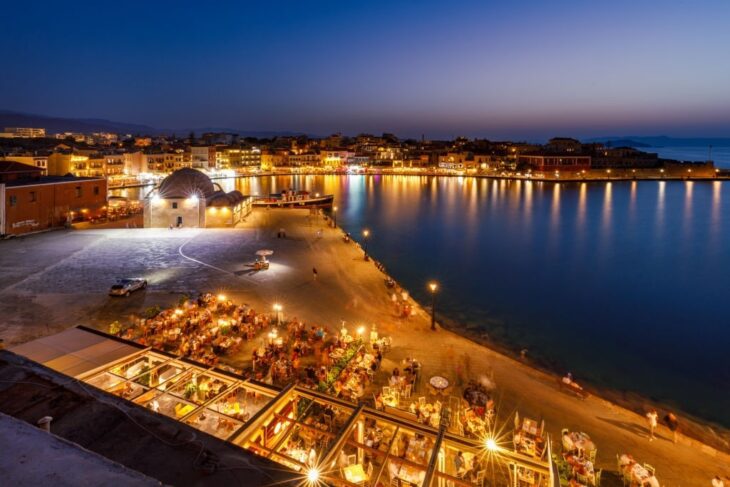
How do you get from Chania to Heraklion?
You can travel from Chania to Heraklion by rental car, KTEL bus, taxi, private transfer, or a connecting flight through Athens. There are 5 practical ways to make the trip, listed below in order of flexibility.
- Car Rental: Renting a car gives you full control of your schedule and lets you stop in Rethymno or along the coast. Most companies offer online booking.
- Bus (KTEL): The standard KTEL bus is the cheapest option, running hourly with stops along the way; the newer EXPRESS service covers the route non-stop in about 2 hours.
- Taxi: A pre-arranged taxi takes you from Chania to Heraklion in about 2 hours, door to door.
- Private Transfer: A pre-booked car or van suits groups and families, with luggage handled and no price negotiation on arrival.
- Flight: There is no direct flight between the two cities, so a connecting flight through Athens makes this the least practical option for this route.
1. Car Rental
Car rental is the most flexible way to travel from Chania to Heraklion. A rental car lets you drive the route at your own pace, stop in Rethymno, and reach beaches and villages the bus does not serve. Booking through a Crete car Rental company requires a valid driving licence, a credit or debit card in the driver’s name, and a minimum age of 21. Car rental in Crete for a week costs around €250, while day trips cost about €30 to €40. A weekly rental typically includes unlimited mileage and a 4-seat, 4-door car with manual transmission and air conditioning. Return the car with the same amount of fuel it had at pickup to avoid extra charges.
The drive from Chania to Heraklion covers about 140 km to 150 km and takes about 2 to 2.5 hours on the E65/E75 north-coast road (national road 90, known locally as the VOAK or BOAK). Fuel for the drive costs about €19 one way, by our estimate. Unleaded 95 cost about €2.21–2.24 per litre in late September 2026, from €2.21 in Chania to €2.24 in Heraklion, according to fuelprices.gr. A small car using 6 litres per 100 km burns about 8.4 litres over 140 km.
A one-way rental suits travellers who land at one airport and fly home from the other. Rental Center Crete adds a flat €60 to the rental price when you pick up the car at Heraklion Airport and return it at Chania Airport, or the reverse. Its rates include insurance with zero excess, no deposit and unlimited mileage, so the cross-island drive adds no mileage charge. Visitors to Crete stayed 7.7 nights on average in 2025, according to INSETE, which leaves time for a day trip across the island within a weekly rental.

The car rental table below sets the main advantages of driving yourself against its main disadvantages.
| Car Rental Advantages | Car Rental Disadvantages |
|---|---|
| Full control over your schedule | Requires a driving licence |
| Reaches places the bus does not serve | Early rental termination fees |
| Easy online booking and payment | Generally higher insurance premiums |
What should you know before driving from Chania to Heraklion?
Drivers from Chania to Heraklion should know that entering the opposite lane and speeding are the 2 manoeuvres most often linked to road deaths in Greece, and that most injury accidents happen in fine weather. 3 Greece-wide figures from the Hellenic Statistical Authority (ELSTAT) report on 2024 road accidents are listed below.
- Entering the opposite lane: Entering the opposite lane was the manoeuvre most often linked to road deaths, with 125 deaths (18.8%).
- Speeding: Speeding above the limit was the second most common manoeuvre, linked to 111 deaths (16.7%).
- Fine weather: Fine weather was the setting for 93.9% of injury accidents, so sunshine is no reason to relax.
Stay in your lane on bends and keep to the posted limit for the whole drive. Plan a stop in Rethymno, roughly halfway, to break up the drive. Local road rules, signs and parking are explained in our page about driving in Crete.
2. Bus (KTEL)
The KTEL bus is the cheapest way to travel from Chania to Heraklion. A single ticket costs €17.60 on both the regular bus and the EXPRESS, according to KTEL’s official fare. KTEL publishes no return fare, so budget for 2 single tickets on a round trip. Regular buses leave Chania Bus Station roughly every hour from 05:15 to 21:30, and the 21:30 departure needs a change at Rethymno. The regular trip takes about 2.5 to 3 hours, because the bus stops at Georgioupolis, Kavros, Rethymno and Bali along the way.
Since 16 June 2025, KTEL has also run an EXPRESS service on the Chania-Heraklion line, operated jointly by KTEL Chania-Rethymno and KTEL Heraklion-Lassithi. The EXPRESS buses cover the approximately 140 km route non-stop in about 2 hours, from central bus station to central bus station. Under the timetable valid from 26 September 2026, EXPRESS buses leave at 09:30, 12:45, 15:30 and 18:45 every day, in both directions. Both services are air-conditioned and allow 2 pieces of luggage per passenger, stored beneath the bus.
The EXPRESS timetable changes with the season. The summer EXPRESS restarted on 4 May 2026, and the current departure times have applied since 1 July 2026. In winter 2026, from 6 February to 31 March, the EXPRESS ran on Fridays and Sundays only. Check the 2026-27 winter timetable on e-ktel.com (KTEL Chania-Rethymno) or ktelherlas.gr (KTEL Heraklion-Lassithi) before a winter trip.
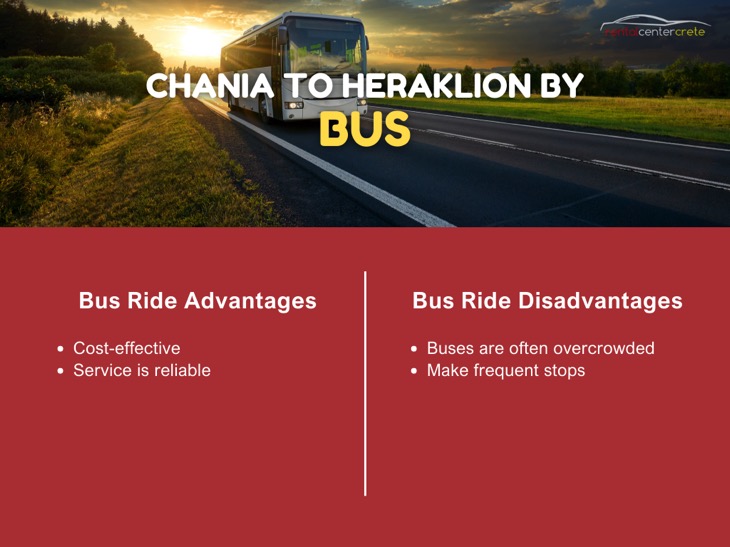
The bus table below sets the main advantages of the KTEL service against its main disadvantages.
| Bus Advantages | Bus Disadvantages |
|---|---|
| Cheapest option | Standard buses can be crowded |
| EXPRESS service runs non-stop in about 2 hours | EXPRESS departs only 4 times a day, fewer in late winter |
3. Taxi
A taxi is a fast, door-to-door way to travel from Chania to Heraklion. A taxi transfer is usually pre-arranged before you arrive in Chania, so the driver takes you straight to your destination with no price negotiation. The trip takes about 2 hours, depending on traffic.
Greek taxi meters follow a national tariff that has applied since 18 September 2026. The tariff sets a €1.80 flag fall, €0.90 per km on Tariff 1, €1.25 per km on Tariff 2, a €4 minimum fare and a €4 airport surcharge. On a metered 140 km trip, those rates work out at about €128 on Tariff 1 and about €177 on Tariff 2, by our calculation. Tariff 2 applies from 00:00 to 05:00 and outside the taxi’s home zone, so most of an intercity trip runs on the higher rate.
Taxi quotes vary with the time of day, the pickup point, the vehicle size and the company, and an airport pickup adds the €4 surcharge. Fixed prices for a pre-booked taxi transfer (opens in a new tab) from Chania to Heraklion start at about €155, and often run €170–180, depending on the number of passengers. Those fixed quotes sit at the top end of the metered range of about €128–177, close to the Tariff 2 price.
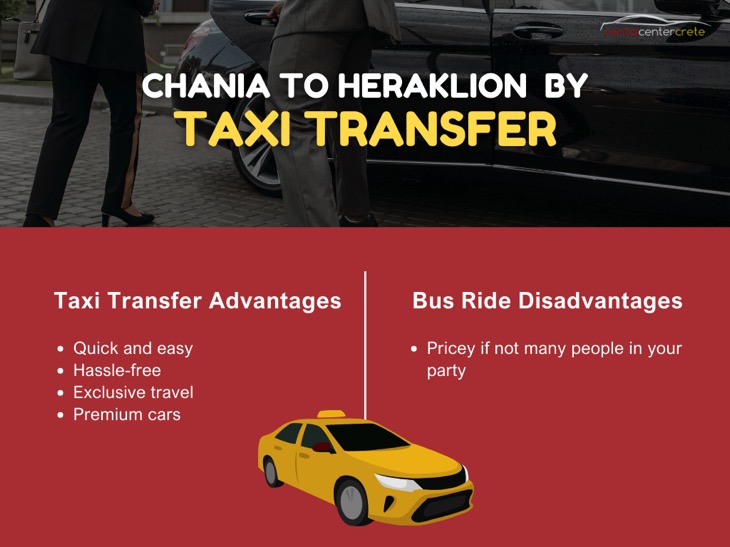
The taxi table below sets the main advantages of a taxi against its main disadvantages.
| Taxi Advantages | Taxi Disadvantages |
|---|---|
| Quick and door-to-door | More expensive than the bus |
| Pre-arranged, no price negotiation | Price rises with distance and passengers |
4. Private Transfer
A private transfer suits groups and families who want to book in advance. Unlike a street taxi, you set the pickup and drop-off points ahead of time, and a driver meets you on arrival. You can choose the vehicle you need, such as a van or minibus, and the driver handles your luggage. A private transfer from Chania to Heraklion takes about 2 hours and costs €120 to €150, depending on the vehicle and the number of passengers.
5. Flight
A flight is the least practical way to travel from Chania to Heraklion, because there are no scheduled flights between Chania Airport (CHQ) and Heraklion Airport (HER). Flying means 2 flights with a change in Athens, on airlines such as Aegean Airlines, Olympic Air and Sky Express. The whole trip takes several hours, which makes flying slower than driving, and fares depend on the date and the airline.
Heraklion “Nikos Kazantzakis” Airport handled 10,033,151 passengers in 2025, about 2.4 times the 4,126,799 at Chania “Ioannis Daskalogiannis” Airport, according to the Hellenic Civil Aviation Authority (HCAA). Fraport Greece, which runs Chania Airport, counts 4,150,829 for the same year. That gap in flight choice is one reason many visitors fly into one airport and out of the other, with a one-way rental car between them. Our comparison of Crete airports, Heraklion vs Chania sets out the differences.
Both airports keep growing. Chania handled 2,933,227 passengers from January to August 2025, up 4.7% on a year earlier (Fraport Greece). Heraklion handled 1,850,790 passengers in August 2026 alone, up 3.4% (HCAA). A new airport at Kastelli, about 39 km south-east of Heraklion, was 67% built in January 2026 and targets a 2028 opening. Drivers from Chania to Kastelli will add about 40 km beyond Heraklion once the new airport opens.
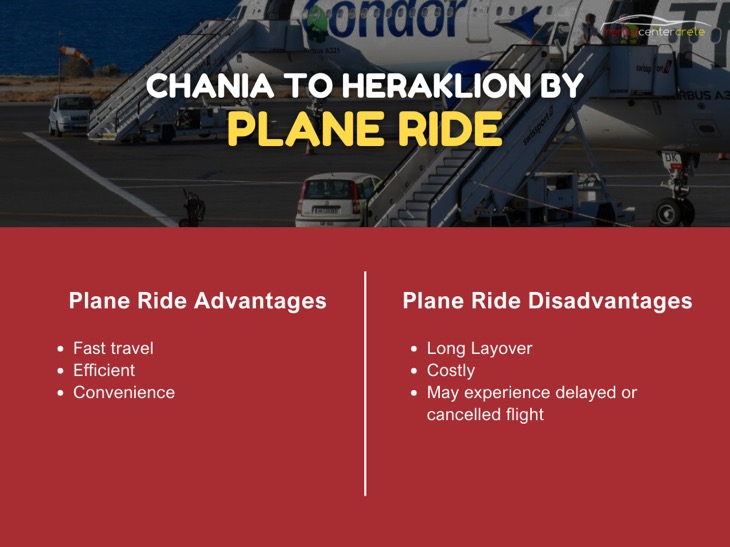
The flight table below sets the main advantages of flying against its main disadvantages.
| Flight Advantages | Flight Disadvantages |
|---|---|
| Fast in the air | No direct flight; layover in Athens |
| An option for long-distance connections | Long total travel time; possible delays |
6. Is there a ferry from Chania to Heraklion?
There is no direct passenger ferry between Chania and Heraklion. Both cities sit on Crete’s northern coast, so ferry operators route their Cretan services to and from Piraeus on the mainland rather than between the island’s own ports. For this route, a rental car, the KTEL bus, a taxi, or a private transfer is faster and simpler than looking for a boat.
What is the best way to get from Chania to Heraklion?
Car rental is the best way to get from Chania to Heraklion, because it gives you control over your schedule. A rental car lets you set your own pace and reach beaches, villages, and churches that public transport does not serve. The KTEL EXPRESS bus suits budget travel, since it covers the route non-stop in about 2 hours for €17.60. Travellers doing the trip the other way can read our guide on how to get from Heraklion to Chania, which covers the same route in reverse.
A one-way trip cost is the price one traveller or one vehicle pays to get from Chania to Heraklion, without the return journey. The table below compares that cost and the journey time for each option.
| Option | One-way cost | Journey time | Notes |
|---|---|---|---|
| Rental car | 1 rental day plus about €19 fuel | About 2 to 2.5 hours | A one-way drop between the 2 airports adds €60 with Rental Center Crete |
| KTEL EXPRESS bus | €17.60 per person | About 2 hours, non-stop | 09:30, 12:45, 15:30 and 18:45 daily, both directions |
| KTEL regular bus | €17.60 per person | About 2.5 to 3 hours | Roughly hourly, 05:15 to 21:30, via Rethymno |
| Taxi | About €128–177 per vehicle on the meter | About 2 hours | Pre-booked quotes start at about €155 |
| Private transfer | Quoted per vehicle | About 2 hours | Price depends on the vehicle and group size |
| Flight | No direct flight | Several hours via Athens | 2 flights with a change in Athens |
What are the nearest towns to Chania?
5 towns near Chania are worth a side-trip stop before or after the drive to Heraklion, listed below.
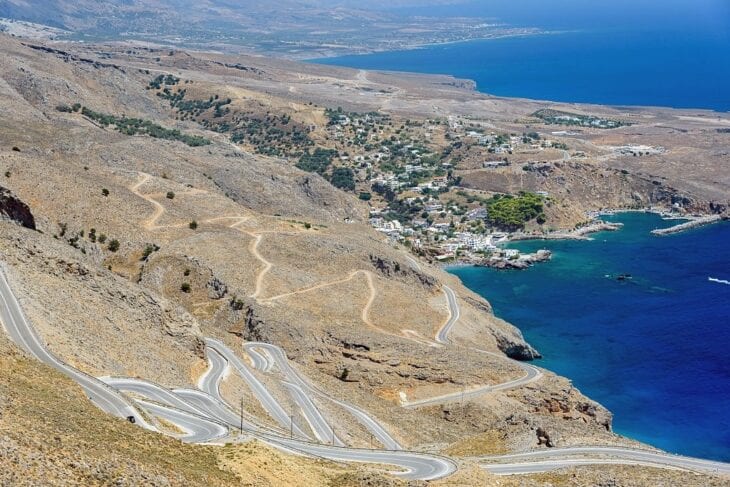
- Sfakia (Chora Sfakion): A small town about 74 km south of Chania on the south coast, near the mouth of the Imbros Gorge.
- Paleochora: A peninsula town about 69 km south of Chania on the southwest coast, along an 11 km stretch of the Libyan Sea coastline.
- Kissamos: A town in the northwest of the island, in the Chania regional unit.
- Frangokastello: A coastal settlement with a Venetian castle, about 11 km east of Chora Sfakion on the south coast.
- Akrotiri: A peninsula north of Souda Bay and northeast of Chania, with sea caves and a plateau landscape.
How far is Chania to Heraklion?
Chania is about 140 km to 150 km from Heraklion by road, which is roughly 102 km in a straight line. KTEL gives about 140 km between the 2 central bus stations, the city-centre drive measures about 149 km, and the drive from Chania Airport to Heraklion Airport is about 162 km. Both cities sit on Crete’s northern coast, connected by the E65/E75 highway (national road 90). You can cover the distance by rental car, bus, taxi, private transfer, or a connecting flight through Athens. Car rental is the most flexible option, because it gives you control over your time along the way.
Is a new motorway being built between Chania and Heraklion?
Yes, a new motorway is being built between Chania and Heraklion, with completion expected around 2030, and in the early 2030s at the latest. The project upgrades the Northern Road Axis of Crete (BOAK) into a 157 km toll motorway between the 2 cities. Law 5204/2025 ratified the 35-year concession, which took effect on 4 February 2026, and its first 5 years cover design and construction. Diktaion Concessions, a company led by GEK TERNA, holds the concession. The European Commission approved the Greek State funding in July 2025 (press release IP/25/1846), and part of the money comes from the EU’s Recovery and Resilience Facility (RRF).
No tolls are charged on the Chania to Heraklion road today. The concession caps the car toll at €0.053 per km before VAT, at 2022 prices. Over the full 157 km, that cap equals about €8.32 before VAT, or about €10.32 with 24% VAT, by our calculation. The cap is indexed, so the real toll at opening is likely to be higher. Deputy Minister of Infrastructure Tachiaos said in the parliamentary debate that trips “with urban characteristics” will not pay tolls, and the law exempts short local trips between set junctions. The Greek State also pays the concessionaire a “shadow toll” of 64.62% on top of each toll charged, because toll income alone does not cover the cost.
The BOAK upgrade has been planned for decades. A 2008 written question to the European Parliament, citing the Technical Chamber of Greece, noted that only 37 km (12%) of the 312 km northern axis had been built with separate carriageways in the previous 20 years. Roadworks can slow the drive until the motorway opens, so allow 3 hours in July and August or near work zones such as Kalyves.
How long does it take to get from Chania to Heraklion?
It takes 2 to 3 hours to travel from Chania to Heraklion, depending on how you go. A rental car takes about 2 to 2.5 hours and lets you stop where you like. The KTEL EXPRESS bus takes about 2 hours non-stop and leaves at 09:30, 12:45, 15:30 and 18:45, while the regular bus takes about 2.5 to 3 hours and runs roughly hourly from 05:15 to 21:30. A taxi or private transfer takes about 2 hours. A flight takes several hours in total because of the change in Athens, which makes it the slowest choice. Traffic is lighter from October to April. Greece-wide, June has the most injury road accidents (1,090) and July the most road deaths (79, or 11.9% of the year), according to ELSTAT’s 2024 figures.
Is it easy to get from Chania to Heraklion?
Yes, it is easy to get from Chania to Heraklion. The route covers about 140 km by road, and you can choose a rental car, bus, taxi, private transfer, or a connecting flight. Land transport is recommended, because flying requires an impractical layover in Athens. The trip takes about 2 to 3 hours depending on the option you choose.
Is it safe to travel from Chania to Heraklion?
Yes, it is safe to travel from Chania to Heraklion for a careful driver, although Crete’s roads are more dangerous than the Greek average. Crete recorded 53 road deaths in 2024, or 85.3 per million residents against 64.0 for Greece as a whole, according to ELSTAT’s 2024 road accident report. Crete has about 2% (1.8%) of Greece’s injury road accidents but 8.0% of its road deaths, so crashes on the island are rarer but more severe. Crete ranks 6th of 13 Greek regions for road deaths per million residents, so it is not the worst region in the country.
A road death rate is the number of people killed on the roads in a year for every million residents. The table below shows how Crete’s rate has fallen since 2000.
| Year | Road deaths on Crete | Deaths per million residents |
|---|---|---|
| 2000 | 122 | 212.0 |
| 2015 | 66 | 105.1 |
| 2024 | 53 | 85.3 |
The long-term fall has not held in 2026 so far. Provisional ELSTAT monthly figures show 21 road deaths on Crete from January to July 2026, up from 14 in the same months of 2025. To drive the route safely, follow the 3 habits below.
- Drive in daylight: Daylight driving gives you a clear view of bends, junctions and slow vehicles on the old national road.
- Hold back on blind bends: Holding back until the road ahead is visible avoids the opposite-lane manoeuvre linked to the most road deaths in Greece.
- Use the hard shoulder with care: Use the hard shoulder to let faster cars pass only when it is clear, and watch for parked cars, cyclists and pedestrians on it.
Breaking the speed limit or crossing a solid line also costs money. Greek traffic fines are listed in our guide to driving violations in Greece.


Leave a Reply