

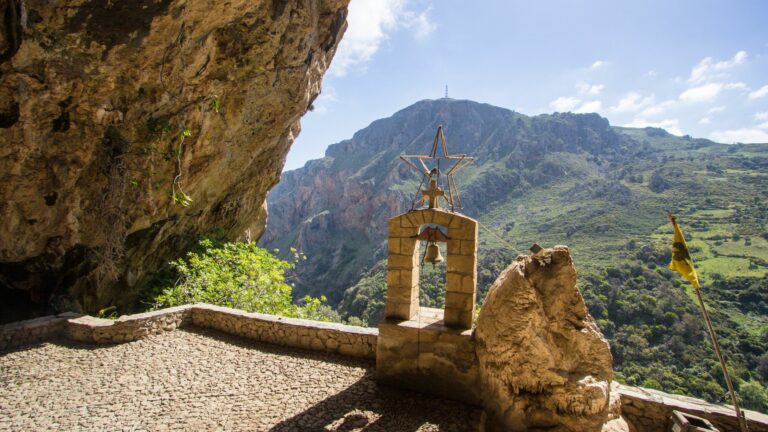
Cave of Agia Sofia is located at the narrowest point of the Topolia gorge on its western edge, and merely 2 km from Topolia village. The Agia Sofia Cave is situated above a slender, stone-built road tunnel leading to the Elafonisi region. Named after the small chapel, measuring 6 by 3 meters, that is uniquely positioned at the cave’s entrance, sharing its left side wall, the cave is reached via a path that ascends from the road level, incorporating steps in certain sections, and climbs to 285 meters above sea level, culminating at a magnificent arched entrance measuring 25 by 10 meters.
Within, the cave unfolds into a vast single dome, 70 meters in diameter and with a variable height of 10 to 20 meters, segmented into smaller areas by dramatic stalagmites. These formations are particularly notable for their sheer size, some reaching heights of 5 to 6 meters, and are yet to connect with their stalactite counterparts above, missing each other by 4 to 5 meters, underscoring the cave’s grand scale. Visitors can closely observe these spectacular formations, the variety of shapes in stalactites and stalagmites, and the algae that swathes portions of the walls in a dark green hue, creating a scene of natural wonder.
The cave holds significance across archaeological, historical, and biological dimensions. Discoveries within include a 4th century B.C. clay figure, shells from the Neolithic, Classical, and Roman periods, and pottery from the Neolithic, Minoan, and Graeco-Roman eras. It is also the exclusive habitat of the Pholcus Creticus spider, making it a steno-endemic site, where a species exists solely in one particular locale.
The cave is shrouded in an array of myths and legends, including one about St. George’s shoehorn, which is said to have left a hoof imprint of his horse on a rock within the cave, a mark that can indeed be found. Another tale recounts Cretan soldiers retrieving the icon of Sophia Wisdom of God from the grand Justinian temple after the Fall of Constantinople to the Turks. This icon was later discovered lodged against a rock inside the cave, precisely at the location where the chapel now stands.
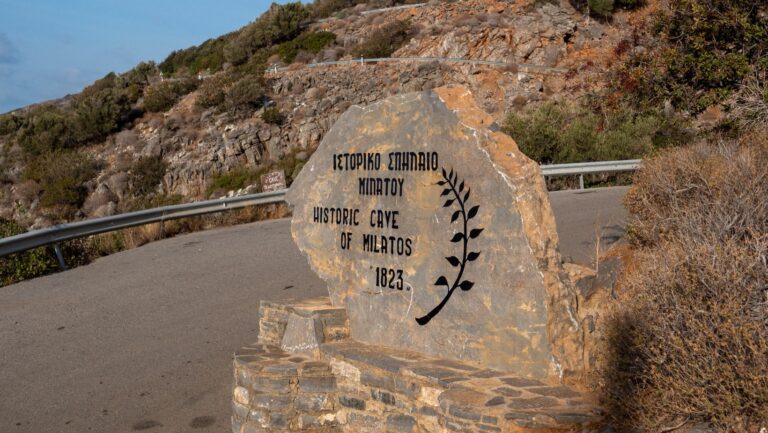
Situated in the Lassithi Prefecture, just 3 km from the village of Milatos, the Cave of Milatos holds a poignant place in local history, despite its scarcity of stalactites and stalagmites. This site is notably remembered for the tragic loss of approximately 3,600 individuals who were massacred by Ottoman forces in February 1823, amid the fervor of the Greek Revolution.
This period marked a significant uprising against Ottoman domination, with Crete joining the Greeks in their quest for liberation. The Ottoman response was harsh, aimed at quelling the insurrection through widespread violence and destruction.
In a desperate bid for safety, the inhabitants of Milatos sought refuge within the cave, with men guarding the entrance while surrounded by Ottoman forces, effectively trapping them. After enduring two weeks of starvation and dehydration from February 3rd to the 15th, the besieged Greeks made a valiant attempt to break free and confront their adversaries, leading to a tragic outcome where many were slain, including 18 priests who were burned alive. The few who survived were sold into slavery in Egypt.
In memory of this somber event, a small chapel dedicated to Saint Thomas was erected inside the cave in 1935, alongside a memorial containing the remains of those who perished. An annual memorial service is held in the cave to honor their memory.
The cave itself is expansive, covering 2,100 sq.m., with dimensions of 73 meters in length and 63 meters in width, featuring eight entrances and varying heights between one and three meters. Archaeological evidence within the cave suggests it was inhabited as far back as the Neolithic era. Visitors can reach the cave by parking in the valley below and following a narrow, 200-meter-long path that winds through a gorge.
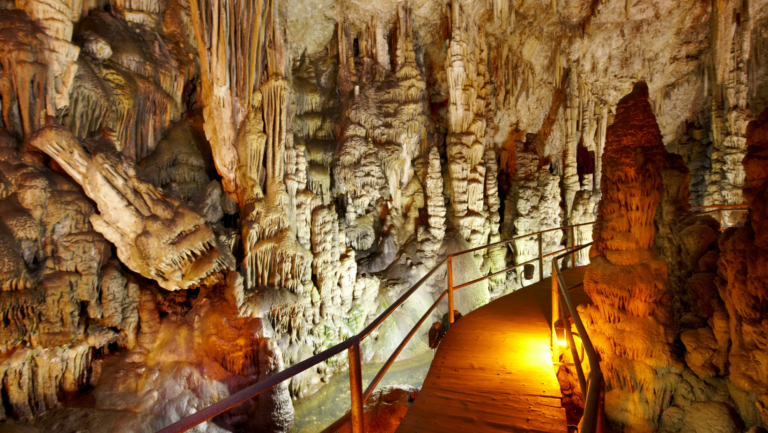
Cave of Zeus is a legendary sanctuary where, according to mythology, the Titaness Rhea hid her son Zeus to protect him from his father Cronus, who had a grim habit of devouring his children. It also serves as the backdrop for the mythological tale of Zeus and Princess Europa. Nestled on the rugged northern slopes of Mount Dikti, at an elevation of 1,025 meters near the village of Psychro, the cave – often referred to as the Dikteon Cave or Psychro Cave – is one of Crete’s most visited archaeological and mythological sites.
Begin your expedition from Stalida, Hersonissos, or Malia, traversing the winding road that ascends to the Lassithi plateau and onward to Psychro. The journey is scented with wild aromatic herbs and offers breathtaking panoramic views. A path bordered by oak trees leads to the cave’s entrance, inviting you to explore.
Upon entering, you’ll be greeted by the cave’s inhabitants: wild rock doves and bats, thriving in the cool darkness. A noticeable chill sets the scene for an exploration filled with wonder. Descend along a clearly defined trail to reach the central chamber after 250 meters, where millennia have sculpted a stunning display of stalactites and stalagmites. The highlight is a grand stalactite that hangs over the lake’s center, known as “Zeus’s cloak.” Evidence of the cave’s historical role as a worship site, including an altar, niches filled with votive offerings, and various archaeological discoveries, underscores its significance. Many of these sacred artifacts are now preserved in the Archaeological Museum of Heraklion.
Visitors can access the cave from 08:00 to 18:00 in the summer months and from 08:30 to 15:30 in the winter.
To explore the depths of the legendary Cave of Zeus, visitors are required to pay a nominal entrance fee of 6 Euros, with free admission for students and a 50% discount for all during the winter months.
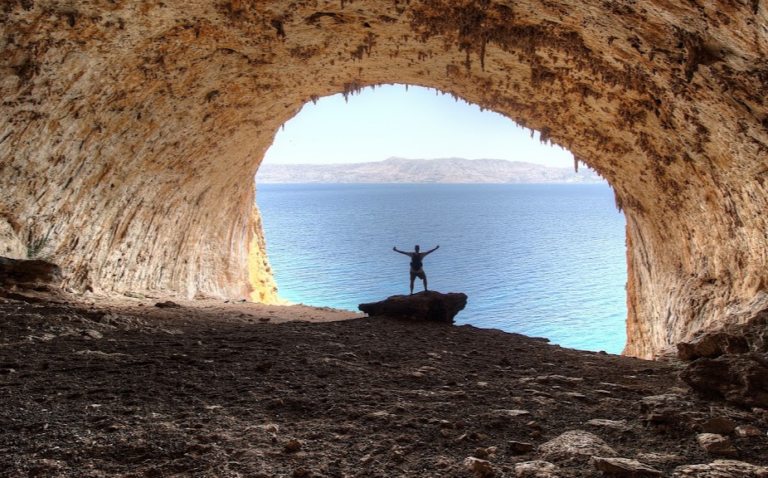
Situated alongside the sea near the Gramvousa Peninsula on the northwest shoreline, Tersanas Cave lies in proximity to the renowned and picturesque Balos Beach. The entire region captivates with its beauty, with Balos frequently ranking among the top ten most breathtaking beaches globally.
No results available
© All rights reserved. Crete Locals