Crete’s historic lighthouses trace centuries of maritime history, CretaOne reports
Several of Crete’s oldest lighthouses, standing at harbor entrances and remote capes from Chania to Sitia, carry histories spanning the Venetian and Egyptian administrations of the island, both World Wars, and the creation of Greece’s modern lighthouse network, according to a report by CretaOne.
The structures range from the heavily photographed Venetian-era tower at the entrance to Chania’s old harbor to an isolated 19th-century lighthouse on the island’s northeastern tip, CretaOne said. Behind each stone tower, the outlet reported, lies a different chapter of the island’s history.
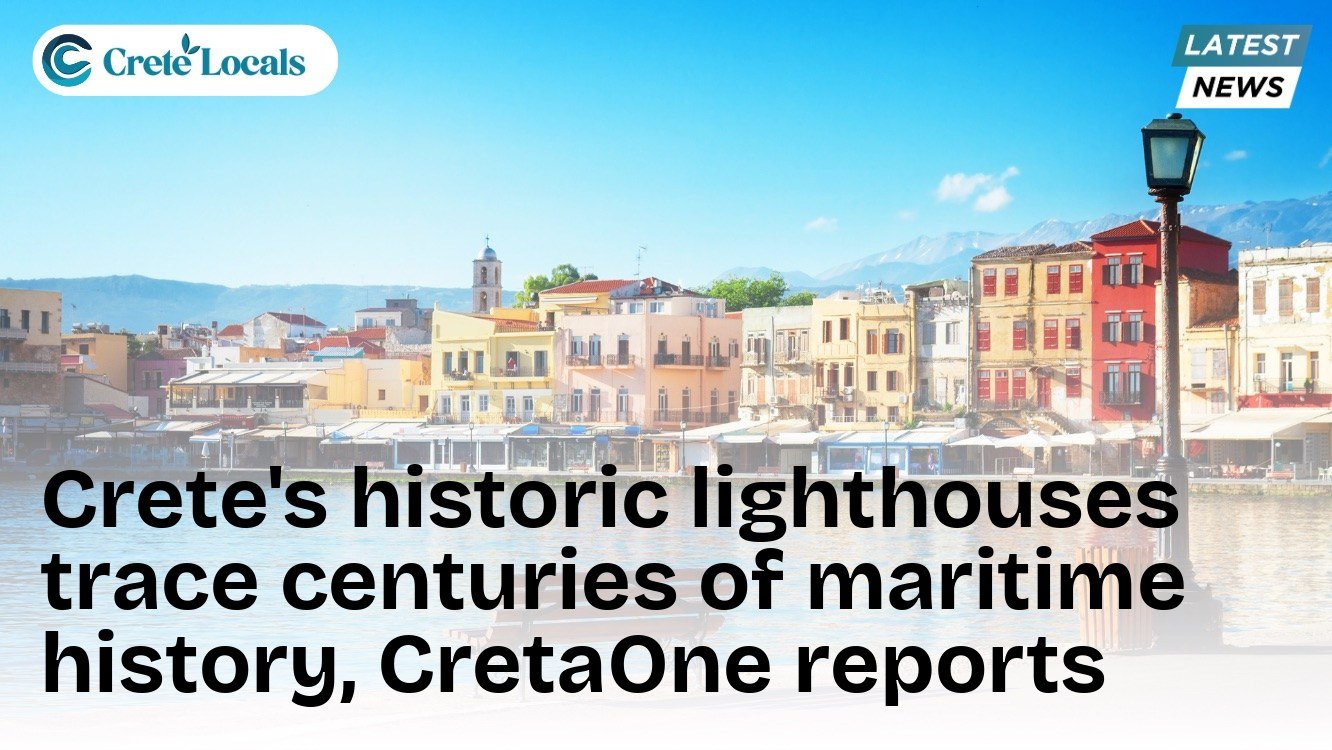
Chania lighthouse: a symbol of the old harbor
The lighthouse at the entrance to Chania’s Venetian Harbor is among the most recognizable in Crete and closely identified with the city, CretaOne reported. According to data cited by the Municipality of Chania, Venetian authorities built a lighthouse at the site between approximately 1595 and 1601.
The structure’s current form took shape much later. During the period of Egyptian administration of Crete, significant harbor works were carried out and the lighthouse tower was rebuilt on the older Venetian foundation, CretaOne said. The present tower consists of three distinct sections: octagonal at the base, hexadecagonal in the middle, and circular at the top.
Its lighting system was destroyed during World War II, and the lighthouse resumed operation after the war ended, according to the report. It remains a defining feature of the old harbor and one of the most photographed sites in Crete.
Rethymno’s Egyptian-era lighthouse
At the edge of Rethymno’s old Venetian Harbor stands another notable lighthouse from the island’s history. The Egyptian Lighthouse of Rethymno is linked to the period when Crete was under Egyptian administration, CretaOne reported, citing the Municipality of Rethymno.
The lighthouse sits at the entrance to the old Venetian harbor, according to the municipality. Because the harbor itself dates from an earlier period, the site brings together two distinct eras of Crete’s history: the Venetian harbor installation and the later Egyptian lighthouse, CretaOne said.
While the lighthouse no longer plays the navigational role it once had, it remains part of the historic center of Rethymno, according to the report.
Drepano: lit since 1864
Away from the busier image of the island’s larger harbors stands a different kind of lighthouse. At Cape Drepano, in the Apokoronas area, a lighthouse has faced the Cretan Sea since the 19th century, CretaOne reported.
According to the Hellenic Navy’s Lighthouse Service, the Drepano lighthouse first went into operation in 1864, while Crete was still under Ottoman rule. Following the union of Crete with Greece, it was incorporated into the Greek lighthouse network, the report said.
Like the Chania lighthouse, Drepano was affected by World War II, ceasing operation before it was restored once fighting ended, CretaOne reported. It was later electrified and continued to serve as a key point in the network. Unlike the lighthouses of Chania and Rethymno, Drepano retains more of the character of an isolated coastal outpost, according to the report.
Cape Sidero: at Crete’s northeastern tip
At the opposite end of the island stands one of Crete’s most remote lighthouses. The Cape Sidero lighthouse is located at the island’s northeastern tip, in the wider Sitia area, CretaOne reported.
Far from major towns and harbors, the setting here is markedly different, with the lighthouse standing in a rugged coastal environment where land gives way to the Aegean, according to the report. The Lighthouse Service states that it was built in 1880 by the French Lighthouse Company, with a tower reaching 15 meters, and was later incorporated into the Greek lighthouse network.
Its history changed sharply during World War II, when the lighthouse was destroyed and remained out of service, CretaOne reported. It was rebuilt and returned to operation after the war, and was modernized and electrified in subsequent decades. More than a century after it was first built, it continues to stand at one of the most remote points on the island, according to the report.
More than a light in the night
Modern navigation technology bears little resemblance to that of the 19th century, with GPS, electronic charts and modern systems having transformed how ships travel, CretaOne noted. Even so, the outlet reported, the lighthouses have not lost their significance.
The Greek lighthouse network continues to be maintained by the Hellenic Navy’s Lighthouse Service, while several of the historic stone lighthouses now also stand as important monuments to the country’s maritime history, according to the report. In Crete, CretaOne said, each one tells a different story: one became the symbol of Chania, another recalls Rethymno’s Egyptian period, Drepano has stood on the Apokoronas coast since the 19th century, and Cape Sidero guards the island’s northeastern edge.
Readers exploring Crete’s coastline and historic places in Crete can find these lighthouses among the landmarks that punctuate the island’s harbors and headlands, alongside other experiences in Crete tied to its layered history.