Rethymno region features 18 notable beaches along Crete’s coastline
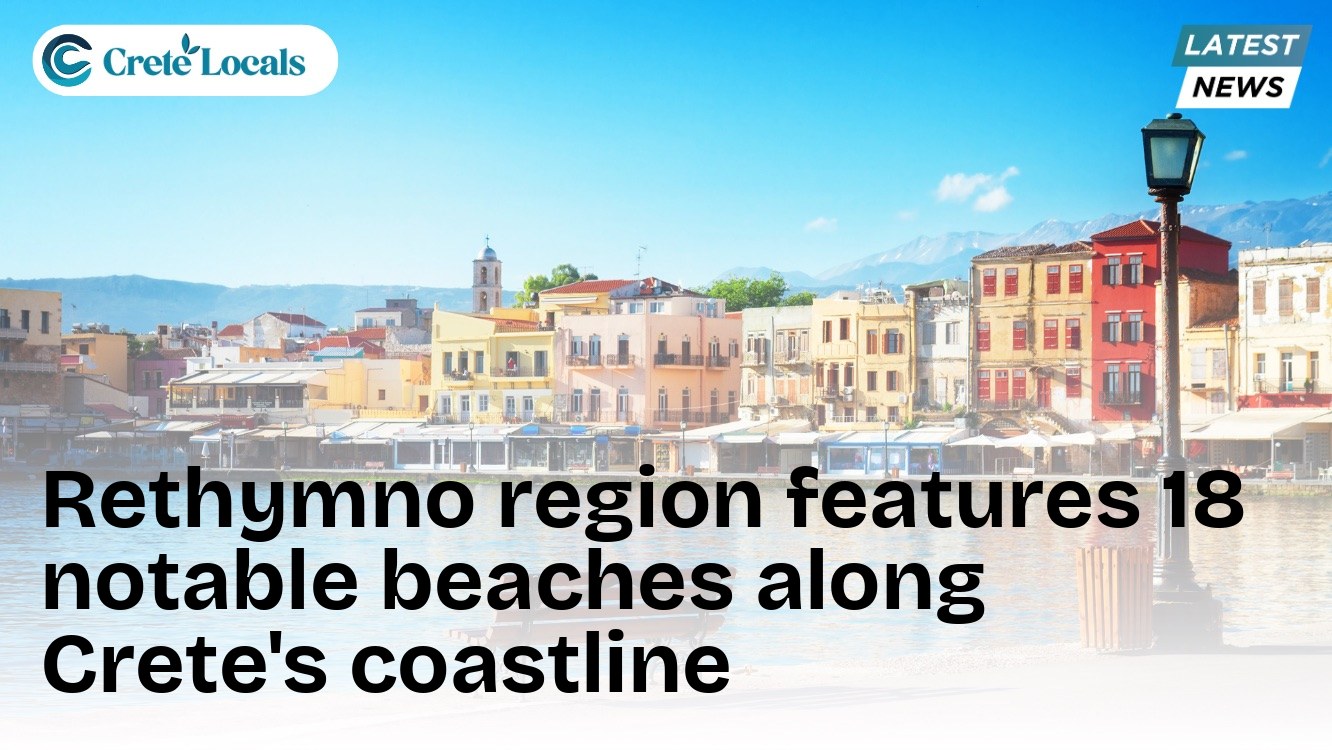
The Rethymno region on Crete’s northern coast includes a range of beaches along its shoreline, from organized sandy stretches near the town of Rethymno to secluded coves reachable only on foot or by boat. The area is also known for its Venetian harbor and fortress, the Fortezza, and for sites linked to Minoan-era history.
Preveli
Preveli beach, on the southern coast, sits at the mouth of a river where palm trees and steep cliffs surround the shore. A small lake forms where the river meets the sea. The beach can be reached via a footpath, or by boat from Agia Galini or Plakias.
Karavostasi
Karavostasi is a small cove near the coastal village of Bali, with fine sand and turquoise water. Nearby caves are accessible only by swimming.
Agios Pavlos
Agios Pavlos beach lies in a secluded bay with a rocky seabed, opposite the village of the same name. Two small islets, known as Paximadia, are visible offshore. A path from the beach leads to nearby Alatsogremnoi, which has larger sand dunes.
Triopetra
Triopetra, meaning “three stones,” is named after three rock formations near the village of Akoumia that divide the area into two separate stretches of beach. It lies at the foot of Mount Siderotas and is accessible by car.
Plakias
Plakias is a village on a plain where the Kotsyfos river flows, with a long sandy beach. Hiking trails from the area lead to the Kotsyfos and Kourtaliotis gorges. The village has cafes, restaurants, accommodation and beach bars.
Livadi
Livadi is the first of four adjoining coves near Bali. It is a large, organized sandy beach.
Ammoudi
The Ammoudi area consists of three adjoining beaches. Megalo Ammoudi has white sand and full facilities. Klisidi is a calmer sandy beach surrounded by rocks. Mikro Ammoudi, or Ammoudaki, has turquoise water and fine white sand.
A separate beach near Plakias, with grey sand and turquoise water, is used by local diving schools due to its marine life.
Souda
Souda beach lies at the mouth of the Foinikas river in a green valley, with a beach of coarse sand. Cretan palm trees grow along the riverbank near the sea.
Ligres
Ligres beach is marked by a large red rock and features coarse sand and deep water. It has no tourist infrastructure.
Episkopi
West of Rethymno, Episkopi beach sits in a plain planted with olive groves, with shallow, clear water. It is bordered by the Mousela river to the west and a river running through the Petra gorge to the east. The beach is named after the nearby village of Episkopi.
Glaros
Between Rethymno and Heraklion lies the small islet of Glaros, opposite a small peninsula, with an isolated beach of the same name.
Katavati
Katavati is a pebble beach next to Glaros, without facilities. It offers views of the Talea mountains, which extend from Psiloritis toward the north.
Spilies
Spilies beach, at the end of a small cove sheltered by steep rock walls, has pebbles and clear water. Its rocky formations and caves provide shelter for the Mediterranean monk seal, according to the source.
Geropotamos
Geropotamos beach lies at the mouth of the river of the same name. The wider area is considered significant for local wildlife, providing shelter for birds and other animals, including the Mediterranean monk seal.
Korakas (Rodakino)
Korakas, also known as Rodakino, is located at the mouth of a river running through the Rodakino gorge. Though organized, it retains fine grey pebbles, blue water and distinctive rock formations. The nearby village of Rodakino is said to be named after a peach tree that reportedly bloomed unexpectedly in the area’s dry climate.
Skaleta
At the end of the Bay of Rethymno, Skaleta is an organized sandy beach known as a nesting site for loggerhead sea turtles (Caretta caretta).
Fotinari
Between Plakias and Souda, Fotinari is a secluded beach at the end of a stream lined with dense vegetation. It has two sheltered coves with rocky seabeds.