
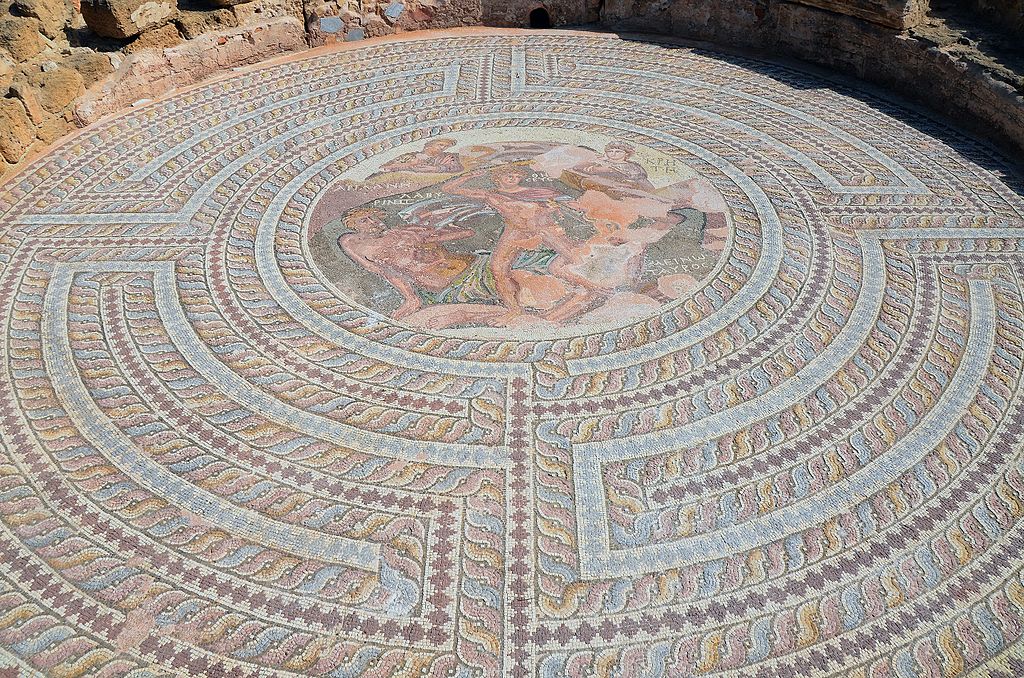
The Minotaur’s Labyrinth was the mythical maze beneath the palace of Knossos on Crete, built by the craftsman Daedalus on the orders of King Minos to hold the Minotaur, a creature with the head of a bull and the body of a man. No separate underground maze has ever been found. Most historians think the palace itself, a sprawling plan of more than a thousand rooms and winding corridors, is what inspired the legend. This guide covers where the story comes from, what the myth actually says, whether the Labyrinth was real, and how you can walk the site today.
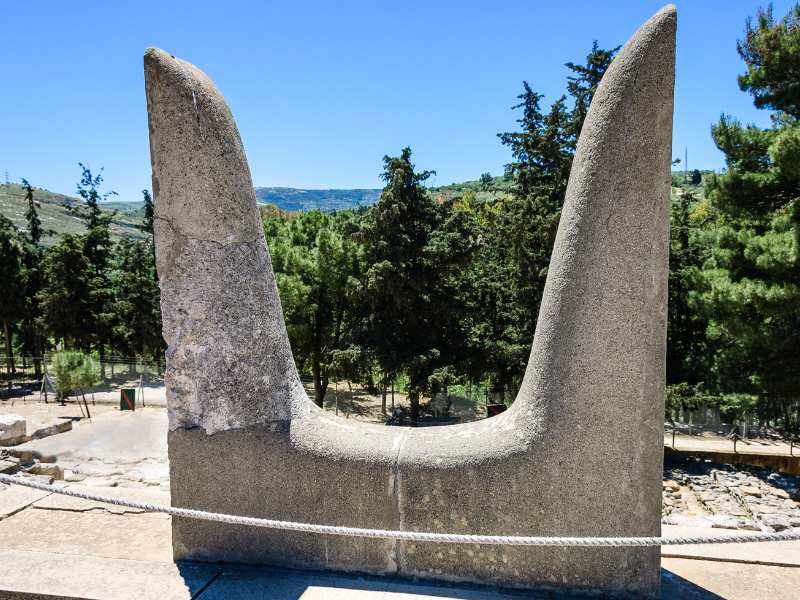
The word may not have started as “maze” at all. At Knossos, archaeologists kept finding the sign of a double-headed axe, called a “labrys” in an old Cretan word. Sir Arthur Evans, who excavated the palace in the early 1900s, argued that “labyrinth” originally meant “the House of the Double Axe”, the building where that symbol was everywhere. A second theory traces the word to “lavra”, meaning a narrow lane, which fits the palace’s tangle of passages just as well. Either way, the name ties the legend directly to the real ruins outside Heraklion. You can read more on our guide to the Palace of Knossos in Heraklion.

Knossos is often called Europe’s oldest city, and its ruins still show frescoes, deep storerooms, and an early drainage system. The complex held more than a thousand rooms across several levels, linked by corridors that turned back on themselves. To a visitor who did not know the plan, moving through it would have felt like being lost in a maze. When Evans dug the site, he was struck by how closely the layout matched the ancient story, and he named the whole civilisation “Minoan” after King Minos.
The story explains why such a creature needed a maze in the first place.
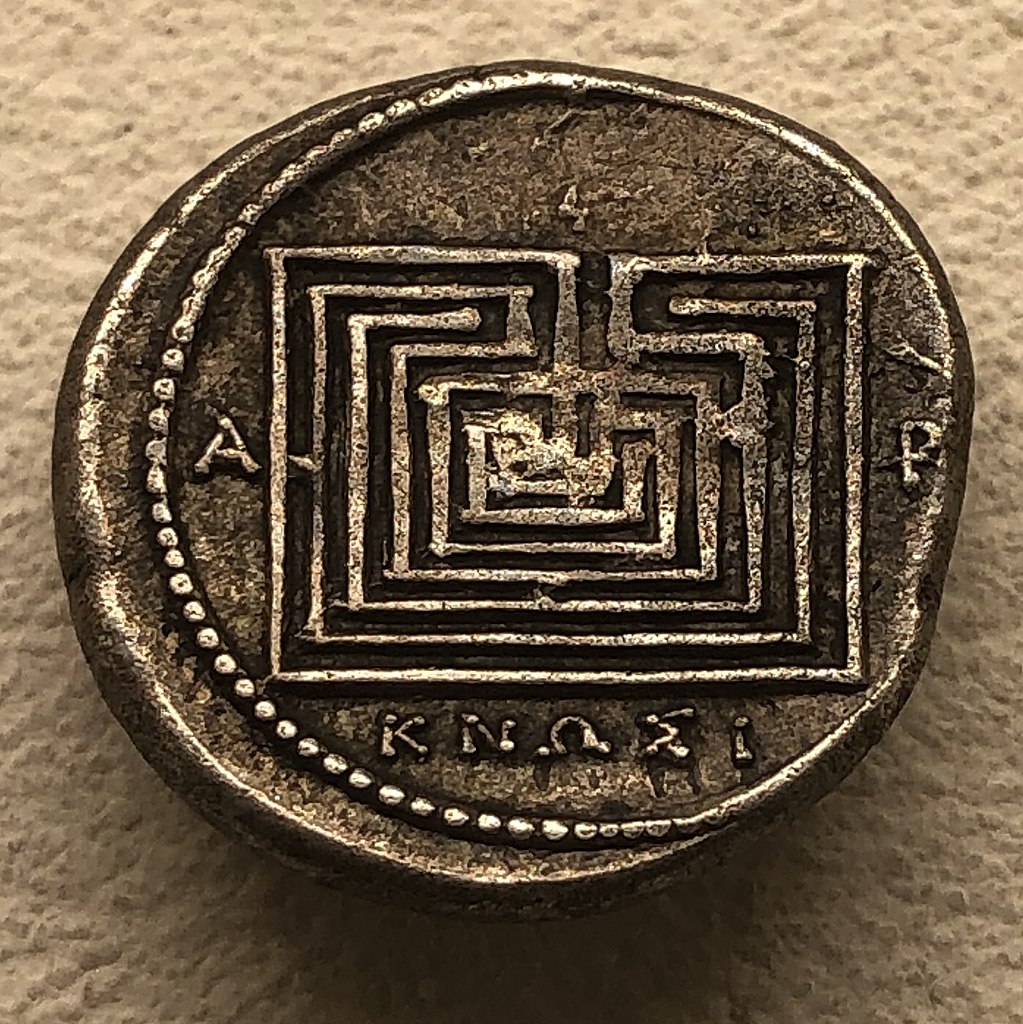
The two words describe different shapes. A true maze is multicursal: it branches, with dead ends and choices, so you can get lost, which is how the myth describes the Minotaur’s prison. A classic labyrinth is unicursal: a single winding path that always reaches the centre, with no wrong turns. The famous Cretan labyrinth design, a seven-ring pattern stamped on the silver coins of Knossos, is the unicursal kind. That design also survives in the Greek Key, or meander, pattern still seen on Greek art and borders.
There is no archaeological evidence of a separate underground maze at Knossos. What excavators found instead was the palace, so large and so intricate that its own plan is the likeliest source of the legend. Two real features of Minoan life fed the story further: the bull was a sacred animal in Minoan religion, and frescoes at the site show acrobats leaping over charging bulls, an image that maps neatly onto a half-bull monster kept within sacred walls. In short, the maze is myth, but the building that sparked it is solid stone you can still walk.
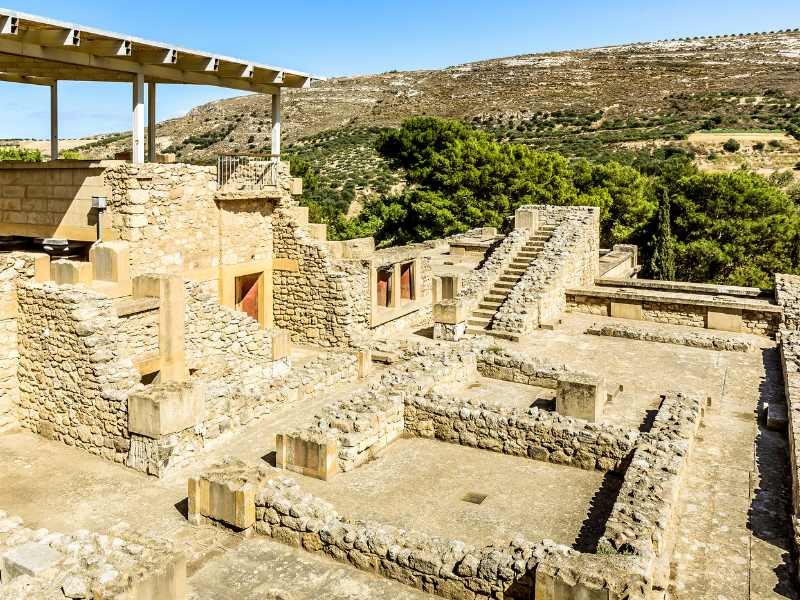
There is no labyrinth room to enter, because there never was one. What you visit is the palace of Knossos itself, on the Kephala hill just outside Heraklion, and its maze-like plan is the closest thing to the legend you can stand inside. Walking the corridors, storerooms, and reconstructed halls is what most guided visits mean by “the Labyrinth”. Knossos sits a short drive from Heraklion town, so pairing it with the Heraklion Archaeological Museum, where the bull-leaping fresco is kept, makes an easy half-day. Reaching the site and the museum on your own schedule is simplest with a rental car in Crete.
The design outlived the palace by thousands of years. It appears on Cretan coins into the first century BC, then on Roman mosaics, and later as a symbol adopted by the medieval church and as garden hedge mazes in the Renaissance. The story keeps being retold: the Minotaur and its maze turn up in the fiction of Jorge Luis Borges, in the Percy Jackson novels, and as a playable version of the palace in the video game Assassin’s Creed Odyssey.
Where is the Minotaur’s labyrinth in Crete? The legend is tied to the palace of Knossos, on the Kephala hill just outside Heraklion in central Crete. There is no separate labyrinth building; the palace ruins are the place linked to the myth.
Can you visit the Minotaur’s labyrinth? You can visit the palace of Knossos, whose maze-like layout inspired the story, but there is no distinct “labyrinth” to walk into. Touring the palace corridors and halls is what visits mean by seeing the Labyrinth.
Is the Cretan labyrinth real? No underground maze has been found. Historians think the palace of Knossos, with more than a thousand rooms and winding corridors, is the real structure that inspired the myth of the Labyrinth.
Who built the Labyrinth and why? In the myth the craftsman Daedalus built it on the orders of King Minos, to imprison the Minotaur so the creature could not harm the palace and its people.
What is the difference between a maze and a labyrinth? A maze is multicursal, with branching paths and dead ends where you can get lost, matching the Minotaur’s prison in the story. A labyrinth, like the seven-ring design on the coins of Knossos, is unicursal: one single path that leads to the centre and back.